Ankle twist or ankle sprain?
“I twisted my ankle” is a commonly heard phrase, but what actually happens? In humans, the joint that connects the lower leg to the foot is called the ankle. At the ankle, two bony prominences are visible, which make the ankle recognizable. These two protruding bones are called the malleoli. Ligaments run over these bony parts, also known as ankle ligaments. The ankle ligaments are strong bands (ligaments) located on the inner (medial) and outer (lateral) sides of the ankle and connect various joints and bone structures.
The function of the ankle ligaments is to stabilize the ankle joint and prevent extreme movements. When you misstep, the ankle makes an unnatural movement. This puts the ligaments under tension and they may even tear.
In the case of a minor ankle twist, the ankle is usually only swollen and the damage is limited. The pain typically lasts for a few days. However, in an ankle sprain, the ligaments are damaged and the ankle no longer functions fully. The pain is more severe and recovery takes longer.
Cause of partially torn ankle ligaments
A cause of an ankle twist or sprain is often an unexpected movement of the ankle joint, where the ankle moves excessively inward or outward. This places maximum strain on the ankle ligaments, resulting in a twist or sprain. An ankle twist or sprain can therefore occur in many different situations, such as stepping off a curb, misstepping on uneven ground, stepping into a hole in the grass, or landing incorrectly after a jump.
Symptoms of partially torn ankle ligaments
- Pain on the outer or inner side of the ankle, especially during movement and weight-bearing
- Swelling of the ankle, sometimes with an egg-shaped bulge
- Bruising or bleeding around the ankle, especially on the outer side
- Difficulty walking, standing, or bearing weight on the foot
- Stiffness and sometimes a feeling of instability in the ankle
- Painful and restricted movement of the ankle
Treatment of partially torn ankle ligaments
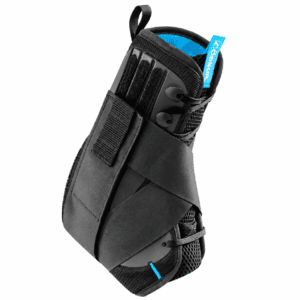
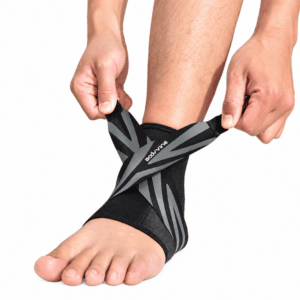
Treatment consists of rest, cooling (during the first 30 minutes), elevating the foot, and avoiding heavy load. An ankle brace or bandage supports the ankle, reduces pain, and helps prevent further injury. Recovery usually takes 2 to 6 weeks; during this period, movement and weight-bearing are gradually increased, possibly under the guidance of a physiotherapist.
Supportive ankle brace for partially torn ankle ligaments
It is extremely important to properly manage an ankle ligament injury, as inadequate treatment may lead to chronic ankle instability.
In the case of an ankle sprain, it is important to rest the ankle initially by elevating the foot and allowing swelling to decrease so the ligaments can recover. Therefore, elbow crutches are often required during the early phase.
To support the ankle ligaments in their function and give them the opportunity to heal, brace therapy can be applied. It is no coincidence that wearing an ankle brace or bandage significantly increases the chances of full recovery, according to the Royal Dutch Society for Physical Therapy (KNGF). Wearing an ankle brace or bandage is recommended once swelling begins to subside. In addition, scientific research has shown that the preventive use of an ankle brace or bandage greatly reduces the risk of recurrence (re-injury) and thus lowers the chance of developing chronic ankle instability.
Which braces are suitable for partially torn ankle ligaments?
For partially torn ankle ligaments, there are specialized ankle braces and bandages that provide firm support without completely restricting movement. Suitable braces are breathable, adjustable, and easy to put on. Consult a ProBrace specialist to choose the right brace for your situation.