What is De Quervain’s disease?
De Quervain’s disease is an inflammation of the tendon sheath on the thumb side of the wrist. The tendons that move the thumb become irritated or overloaded. This condition, also known as De Quervain’s tenosynovitis, often causes pain on the thumb side of the wrist during gripping, pinching, or twisting. Due to repeated strain, the tendons may move less smoothly, leading to discomfort during daily activities.
Location of the tendons and thumb side of the wrist
The involved tendons run from the forearm toward the thumb and pass through a narrow tendon sheath on the outer side of the wrist. This structure provides stability and control of the thumb but also makes the area sensitive to overload from repetitive movements.
Tendon sheath inflammation (De Quervain’s tenosynovitis)
With overuse, the tendon sheath can become irritated or inflamed. This leads to swelling and friction around the tendons, causing pain when moving the thumb or wrist. This tendon sheath inflammation is characteristic of De Quervain’s disease.
Gradual overuse of the thumb tendons
In addition to inflammation, there may be prolonged irritation and thickening of the tendon tissue. This reduces tendon flexibility and can cause symptoms to persist longer. The condition usually develops gradually without a clear moment of injury.
Development of De Quervain symptoms
When the tendons and tendon sheath are overloaded for a long time, De Quervain’s disease can develop. This often occurs due to repetitive hand and thumb movements such as smartphone use, lifting, working with tools, or picking up a baby. For this reason, the condition is sometimes called “mother’s thumb.”
Cause of De Quervain’s disease
De Quervain’s disease often occurs when the same movements are repeated frequently, such as pinching and lifting. It can also be associated with sports like hockey, tennis, or volleyball. Repeating the same motion over and over can irritate and overload the tendon.
De Quervain’s disease is common among new parents or caregivers of babies. Frequently lifting and carrying a child repeatedly loads the thumb and wrist, which can lead to tendon irritation. That is why the condition is sometimes called “mother’s thumb,” although both mothers and fathers can develop these complaints.
Symptoms of De Quervain’s disease
- Pain on the thumb side of the wrist
- Pain when pinching, gripping, or twisting
- Swelling or tenderness around the thumb tendons
- Reduced strength in the hand and thumb
- Pain when lifting objects or babies
Treatment of De Quervain’s disease
Treatment of De Quervain complaints focuses on reducing strain and allowing the tendons to recover. Rest, adjusting activities, and targeted exercise therapy play an important role. A thumb brace or wrist-thumb brace can provide support by limiting thumb movement and relieving the tendons. Recovery can take several weeks to months, depending on the severity of the symptoms and the level of strain.
Supportive thumb brace for De Quervain
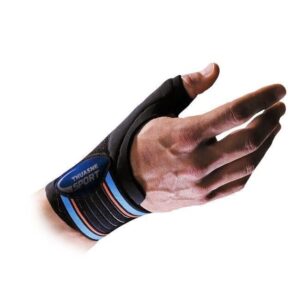
A thumb brace supports the wrist and thumb in De Quervain’s disease by relieving the tendon sheath and limiting unwanted movements. This helps reduce pain and provides more confidence during work, sports, and daily activities. The brace stabilizes the thumb without completely blocking hand function.
Which braces are suitable for De Quervain’s disease?
For De Quervain’s disease, thumb braces and wrist-thumb splints that keep the thumb in a neutral position are suitable. These braces reduce strain on the tendons and provide support during recovery. Depending on the symptoms, you can choose a light elastic brace or a firmer thumb splint for extra stability.
Benefits and features of a thumb brace for De Quervain
Wearing a thumb brace for De Quervain’s disease can help relieve the tendons and reduce pain during movement. A good brace stabilizes the thumb and wrist, improves joint control, and supports recovery from tendon sheath inflammation.
- Relieves the tendon sheath and thumb tendons
- Reduces pain on the thumb side of the wrist
- Stabilizes the thumb and wrist during movement
- Helps prevent tendon overuse
- Provides more control during daily activities
- Suitable for work, sports, and daily use
- Comfortable and adjustable design
- Limits movement without full immobilization