What is pectus carinatum?
Pectus carinatum is a chest wall deformity in which the breastbone protrudes further forward than usual. The condition is also sometimes referred to as pigeon chest.
The breastbone is connected to the ribs by cartilage. In pectus carinatum, the breastbone and adjacent rib cartilage develop in such a way that part of the chest protrudes forwards. This may be visible in the centre of the chest, but the protrusion can also be more pronounced on one side.
Your breastbone protrudes or sticks out
Have you noticed that your breastbone protrudes forwards or that part of your chest clearly sticks out? This may be a sign of pectus carinatum. In children, the abnormal shape may only become clearly visible during a growth spurt, when the chest is changing rapidly.
Not everyone with a protruding breastbone has pectus carinatum. There are several different types of chest wall deformities. It is therefore advisable to have a noticeable or changing chest shape assessed if the cause is unclear.
What causes pectus carinatum?
The exact cause of pectus carinatum is not always clear. The condition is related to the development of the breastbone and the cartilage that connects the ribs to the breastbone. Pectus carinatum often becomes more noticeable during the rapid growth that occurs during puberty.
Pectus carinatum is more common in boys than in girls. The condition can also run in families. The severity and shape of the protruding chest can vary considerably from person to person.
Characteristics of pectus carinatum
The most recognisable characteristic is the shape of the chest. In some people, only a small protrusion is visible, while in others the breastbone clearly projects forwards.
Common characteristics
- A breastbone that protrudes forwards
- A chest that projects outwards at the front
- Protruding rib cartilage next to the breastbone
- A difference between the left and right sides of the chest
- A deformity that becomes more noticeable during a growth spurt
- Occasional tenderness or discomfort around the chest
Pectus carinatum is often primarily visible externally. Some people also experience physical discomfort. The visible deformity can also affect how someone feels about the appearance of their chest.
Treatment of pectus carinatum
Whether treatment is necessary depends on factors including the severity of the pectus carinatum, age and flexibility of the chest. With a mild deformity, monitoring its development may be sufficient.
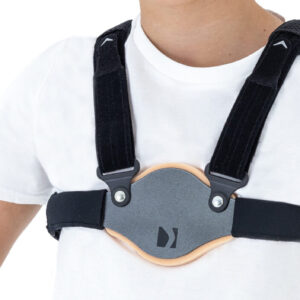
When correction is desired and possible, a special pectus carinatum brace can be used. Particularly when the chest is still flexible, prolonged controlled pressure can gradually influence the shape of the chest.
Severe or complex forms may require a different type of treatment. A doctor or specialist can assess which approach is most appropriate for the individual situation.
How does a pectus carinatum brace work?
A pectus carinatum brace is specifically designed to apply controlled pressure to the part of the chest that protrudes forwards. At the back, the brace provides counterpressure and stability. The principle is comparable to gradually changing the position of teeth with orthodontic braces: prolonged, controlled pressure is used to influence the shape step by step.
A pectus carinatum brace must fit correctly and apply pressure in the right place. The required pressure and wearing time vary from person to person. It is therefore important that the use of a corrective brace is properly adjusted and that the skin is regularly checked for unwanted pressure points.
Benefits of a pectus carinatum brace
- Applies targeted pressure to the protruding area of the chest
- Supports the chest at the front and back
- Can be adjusted to the shape of the chest
- Provides a non-surgical option for correction
- Adjustable models can be modified throughout the treatment process
Pectus carinatum brace for children
Pectus carinatum often becomes more noticeable during childhood or adolescence. Because the chest is still relatively flexible during growth, this can be a suitable time to assess whether treatment with a brace is possible.
A brace for children should fit properly and provide sufficient corrective pressure without restricting breathing. As children grow, it is important to regularly check whether the brace still fits correctly.
Pectus carinatum brace for adults
Special pectus carinatum braces are also available for adults. In adults, the chest is generally more rigid and less easily reshaped than in children and adolescents. As a result, the extent to which the shape of the chest can be influenced with a brace varies from person to person.
An adult pectus carinatum brace should be firm enough to provide targeted pressure while still fitting comfortably. If you are unsure, have your situation assessed to determine whether a brace is suitable and what degree of correction is realistic.
Which pectus carinatum brace do you need?
The right pectus carinatum brace depends on factors including age, chest circumference, the location of the protrusion and the shape of the chest. A well-fitting brace applies corrective pressure in the right place and remains stable while being worn.
ProBrace offers various solutions for children and adults. Before ordering, carefully take the indicated body measurement and check the size chart for the selected product. Are you unsure between two braces or about the correct size? Ask a ProBrace specialist for advice.
When should you seek medical assessment?
Have a noticeable change or abnormal shape of the chest assessed if it has not yet been established that it is pectus carinatum. Medical assessment is also advisable if pain, shortness of breath or other physical symptoms occur.
A specialist can determine which type of chest wall deformity is present and assess whether brace treatment is appropriate. In the event of sudden chest pain or pressure, or severe shortness of breath, it is important to seek immediate medical attention.