Hamstring injury: information about injuries, strain and rupture
A hamstring injury is a common muscle injury at the back of the thigh, especially in athletes who sprint, jump or decelerate suddenly. The hamstrings consist of three muscles – the m. semitendinosus, m. semimembranosus and m. biceps femoris – which connect the ischial tuberosity to the lower leg. These muscles allow the leg to move backwards and the knee to bend. When these muscles are overloaded, the muscle fibres can stretch or tear, resulting in a hamstring strain or a more severe hamstring rupture.
A hamstring injury usually occurs during an explosive movement, for example when starting a sprint or decelerating suddenly. At that moment a large tensile force is placed on the muscle–tendon junction – the most vulnerable part of the hamstring. The biceps femoris is often involved. The result is a sudden, sharp pain at the back of the thigh, making it necessary to stop sporting activity immediately.
The severity of the injury ranges from a mild strain to a partial or complete tear. In some cases swelling or bruising appears immediately. Recovery from a hamstring injury requires time, rest and a gradual build-up of strength and flexibility. Physiotherapy, light stretching and strengthening exercises and a controlled return-to-training program help to repair the muscle fibres and prevent recurrence. A good warm-up and muscle care are essential to avoid new injuries.
Symptoms and how can I recognize a hamstring injury?
There are several important symptoms associated with hamstring injuries. These are listed below:
- Acute pain at the back of the thigh, usually during or after sports activities.
- Bending the knee against resistance is painful.
- Stretching the muscle is painful.
- If many muscle fibres are torn, it may feel as if a piece has been taken out of the muscle.
- Pressure on the torn fibres is painful.
- There is a loss of strength.
- The torn muscle may tighten and cause cramping.
- In case of bleeding, a dark bruise may appear at the back of the leg (this will gradually move downward due to gravity).
- Swelling can be felt at the back of the leg, just below the buttock.
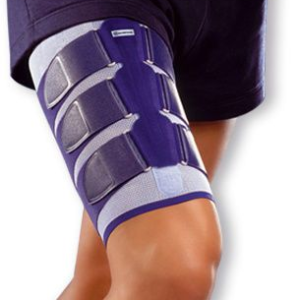
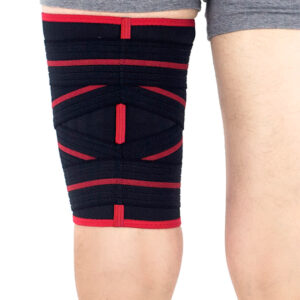
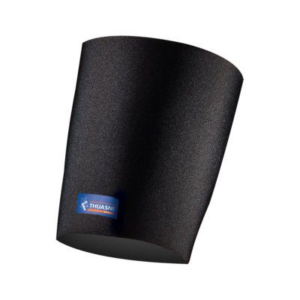
Treating a hamstring injury with a thigh brace!
Recovery typically takes six to eight weeks for a partial rupture. In the case of a full rupture, when the muscle has completely torn, surgery is required. Recovery may then take up to three months. It is strongly recommended to have the surgery performed within a week, as healing becomes less effective afterward.
ProBrace can advise you to keep the muscle warm and supported with compression during daily activities or sports after a hamstring injury.