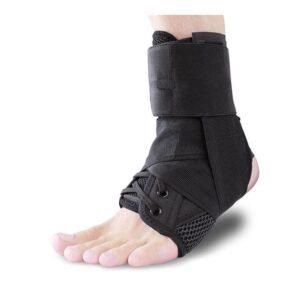
What is ankle instability?
Ankle instability means that the ankle joint is not stable enough to properly control movements. This often occurs after a previous ankle injury, such as a sprain, where the ankle ligaments were stretched or damaged. This can lead to a weak ankle that is more prone to rolling. People with ankle instability often experience an unstable or uncertain feeling, especially on uneven surfaces or during sports activities.
Causes of ankle instability
The most common cause of ankle instability is a poorly healed ankle sprain. When the ankle ligaments do not fully recover or are not adequately trained, the joint remains less stable. Repeated sprains, muscle weakness, reduced coordination, or poor balance can also contribute to the development of an unstable ankle.
Symptoms of an unstable ankle
- Frequently rolling the ankle
- An uncertain or unstable feeling in the ankle
- Pain or fatigue around the ankle joint
- Swelling after exertion or prolonged walking
- Reduced confidence during sports or on uneven surfaces
What to do in case of ankle instability?
Ankle instability usually occurs after a severe or repeated sprain of the joint. There are several important symptoms to determine if an ankle is (chronically) unstable. One of the main symptoms is that the ankle frequently rolls during sports, walking, or even while standing. Often, the muscle-tendon-ligament complex around the ankle is too weak, causing the ankle to easily give way.
To prevent frequent ankle rolling, it is advisable to consult a specialist, such as a physiotherapist. For additional support, you can use ankle braces or ankle supports. Scientific research has shown that rehabilitation with an ankle brace or support is faster and more effective than without one (Source: KNGF).
Treatment of ankle instability
Treatment for ankle instability focuses on improving stability, strength, and control. Exercise therapy and balance training play an important role. Additionally, an ankle brace can provide support during daily activities and sports. A brace helps limit instability in the ankle, reduces the risk of re-injury, and offers extra confidence during movement. In some cases, guidance from a physiotherapist is recommended.
Why buy ankle braces or supports?
According to the current guidelines of the KNGF (Royal Dutch Society for Physiotherapists), wearing ankle braces or supports is advised once the swelling around the joint has decreased. You can increase the chance of full recovery by wearing a brace or support for your ankle for 6 weeks immediately after the swelling subsides. Preventive use of ankle braces and supports significantly lowers the risk of repeated injury.
Which braces are suitable for ankle instability?
For ankle instability, braces that provide firm support while offering comfort are suitable. Examples include adjustable ankle braces or elastic supports that stabilize an unstable ankle. A specialist can help choose the right brace, tailored to the level of instability and intended use, such as sports or daily activities.