Hamstring Injury; What Now?
A hamstring injury occurs more often than you think. From a sudden “pop” during sports to a nagging pain at the back of the upper leg. The hamstring is a sensitive muscle group, both for recreational athletes and professionals. In this blog you will read exactly what happens in a hamstring injury, how recovery proceeds and when a brace or other support may help.
What are hamstrings
The hamstrings are a group of three muscles located at the back of the upper leg. These muscles connect the lower leg to the ischial tuberosity (sit bone). They allow you to bend your knee and extend your hip. Essential for walking, jumping, and sprinting. Because they are heavily involved in powerful movements, they are also vulnerable to overload or tearing. The three muscles that form the hamstrings are named: m. semitendinosus, m. semimembranosus and m. biceps femoris.
How does a hamstring injury occur?
A hamstring injury can occur when a sudden big force is placed on the hamstring tendon — for example during sports, when starting a sprint or suddenly braking. It can also happen during sports that involve jumping or kicking.
At those moments a high tension is placed on the hamstring tendon, and the risk of tearing increases. A tear causes pain at the back of the thigh, making further sports impossible.
Several factors can increase the risk of a hamstring injury:
- Inadequate warm-up or lack of flexibility
- Short or stiff hamstrings
- Poor trunk or glute muscle control
- Previous hamstring injury
- Fatigue or overloading
Professionals often distinguish three degrees of injury:
- Grade 1: mild strain. Light pain, little loss of strength.
- Grade 2: partial muscle tear. Clear pain, possible bruise, difficulty walking.
- Grade 3: full tear. Often audible “pop,” immediate swelling; sometimes surgery needed.
What should you do if you have a hamstring injury?
The first step is rest and ice to limit swelling. Avoid stretching or strength training in the first days. A physiotherapist can then assess the extent of the tear and together with you draw up a recovery plan.
In a light injury, recovery can take place within 2–4 weeks; for more severe tears, this can be 6–12 weeks or longer.
Rehabilitation
The treatment path depends on the degree of injury.
Grade 1 strain
When it concerns a grade-1 strain, only about one to five percent of muscle fibers are damaged or overstretched. Bending the leg may feel uncomfortable, but walking at a slow pace is usually possible with little pain. There is generally no visible swelling in the thigh, though slight tingling may occur. With adequate rest, this type of strain usually heals on its own.
Grade 2 partial tear
With a grade-2 tear there is clear swelling and pressing the hamstring area is painful. Even light load, like walking or cycling, causes pain. In this case it is advised to see a physiotherapist. Even at this level the braces mentioned earlier may help.
Grade 3 complete tear
With a grade-3 tear there is a large swelling in the thigh. The pain then affects not only the hamstring but also surrounding muscles. Walking is only possible with crutches. In this case the muscle is fully torn and surgery is often the only solution.
When should you see a specialist?
Do you have severe swelling, bruising or did you hear a clear “snap”? Or do the complaints persist for longer than two weeks? Then it is wise to consult a doctor or physiotherapist. They can assess whether additional examination is necessary.
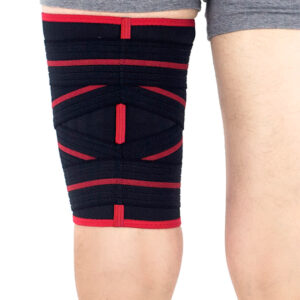
Support with a brace
| Product name | Description / Application | Material / Properties |
|---|---|---|
| Thuasne neoprene thigh brace | Provides compression and warmth for hamstring or quadriceps complaints. Suitable for muscle tears, strains and to prevent overload. | Neoprene material, elastic and easy to put on. |
| Bauerfeind MyoTrain thigh brace | Professional brace for acute or chronic hamstring and quadriceps injuries. Helps recovery after muscle tears or contusions. | Double compression straps, silicone anti-slip edges and anatomical fit. |
| Reh4Mat neoprene adjustable thigh brace | Firm support for strains, muscle tears or bruising of the thigh. Also suitable during rehab training. | Adjustable Velcro straps, breathable neoprene, universal left/right. |
| Bodyvine lightweight thigh bandage (Sport) | Supports mild muscle fatigue or early symptoms during sports activities. | Compression fabric with silicone print, lightweight, breathable, supplied as a set of two. |